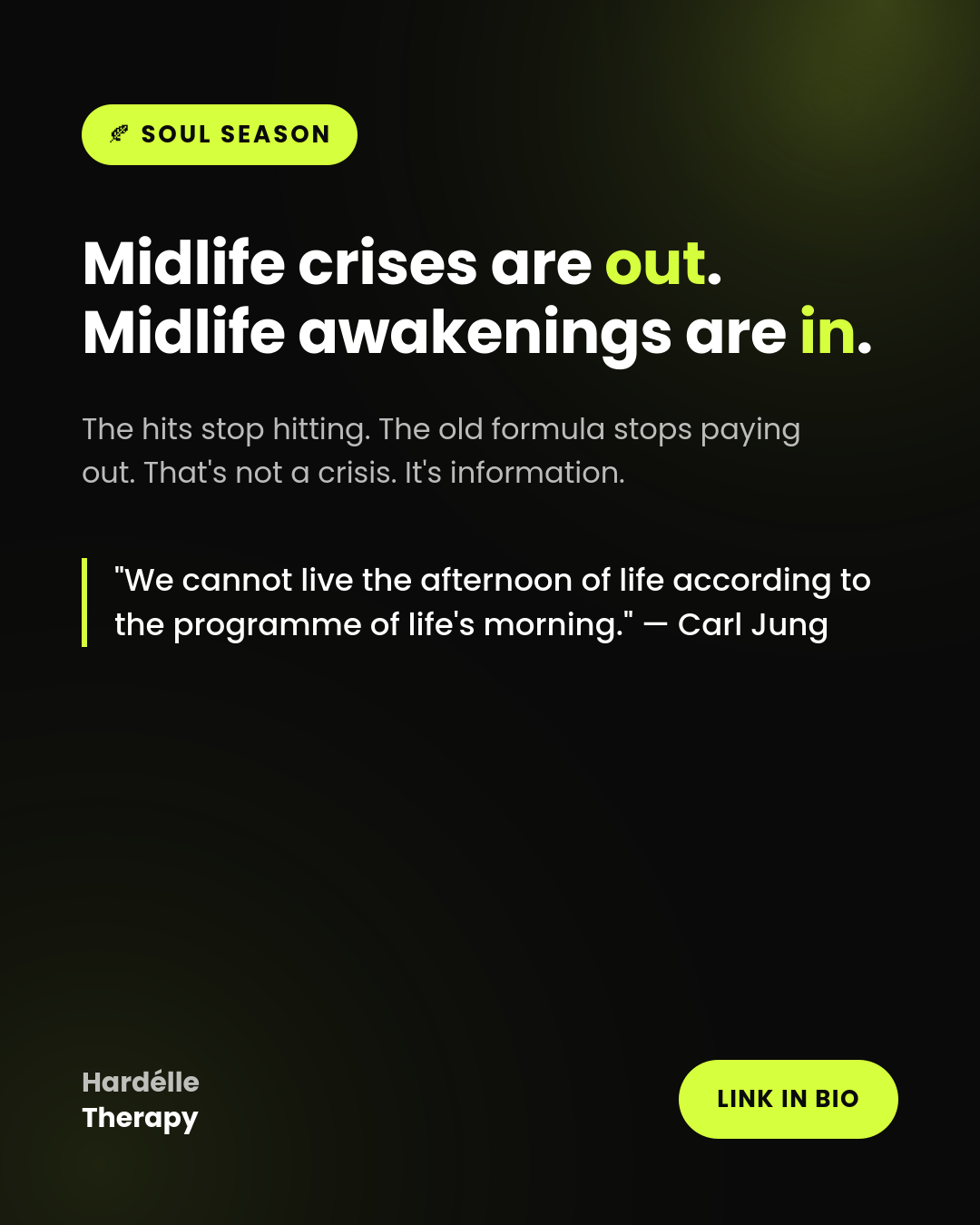
Midlife Crises Are Out. Midlife Awakenings Are In.
I hear a version of this a lot in my therapy room.
Usually from people who are doing well by every measure that's supposed to matter. Successful. Good careers. Decent money. Nice homes. Relationships, holidays, friends. They built the life they were told to build, followed the instructions, assembled all the flat-pack furniture of adulthood.
And then somewhere around their late thirties or forties, they sit opposite me and say some version of:
I don't understand why none of it makes me happy anymore.
The things they used to enjoy don't quite land the same way. They achieve the thing and immediately need another thing. They're bored in their relationship. Or bored dating. Or suddenly questioning a career they spent fifteen years building. They've got a life that looks good on paper and in photographs, and something about it still doesn't feel right.
I know this feeling intimately, because I spent years trying to solve it by adding more.
More excess. Bigger house. Better cars. More friends, more lovers, a better body, whatever that even means. More holidays, more parties, more experiences, more escape. More hedonism. And, at times, probably addiction, if we're being honest about what that word actually covers.
Basically: if something felt good, my instinct was to have more of it. For a while, that works. Right up until it doesn't.
Carl Jung called this stretch of life "the afternoon of life." He believed that somewhere around midlife, the psychological work we're here to do quietly changes shape underneath us, whether we've agreed to it or not.
"We cannot live the afternoon of life according to the programme of life's morning."
I keep coming back to that line, because it lets me off a hook I didn't know I was hanging from. What if nothing has gone wrong? What if you're just trying to feed yourself with something you're no longer hungry for?
That's what happened to me. I kept going back to the same restaurant and ordering bigger portions. Sometimes literally, in different countries. More of the same, hoping I'd eventually feel full. Increasingly, I didn't. I'd have the experience, the sex, the holiday, the party, whatever the thing was, and afterwards there was a drop. And I was still hungry. Sometimes more hungry than before I started.
That was the confusing part. The things weren't bad. Some of them were genuinely brilliant. They just weren't answering the question I kept asking them.
And when the hedonism stopped hitting the spot, my sense of who I was did a spectacular backflip, the kind you'd give a ten for difficulty and a two for landing. I had no clue who I was away from the excess. My ego had built quite an elaborate life around it: the house, the cars, the money, the body, the lovers, the experiences. Being wanted. Being interesting. Being busy. Being able to say yes to almost anything I wanted, whenever I wanted it.
Jung had a line for this too, one I think about every time a client tells me they "don't know why" they keep repeating a pattern they can see perfectly clearly from the outside:
"Until you make the unconscious conscious, it will direct your life and you will call it fate."
Nothing is fate. Most of it is just unexamined appetite.
Year by year, the things I'd built my identity around became less valuable to me. Not worthless. Just quieter. The big house, we left. The luxury cars were returned. The expensive holidays got replaced by experiences that made me feel more connected than impressed. The lovers got swapped, gradually, for more time alone. Making money without really working got replaced by working harder than I probably ever have, on something that actually means something to me.
None of this happened as a beautiful spiritual awakening, for the record. Most of it unravelled painfully, in the way most true things do. I haven't transcended my ego either, and I'd be suspicious of anyone who tells you they have. I still like beautiful things. I like nice hotels. I like clothes. I like sex. I like being desired. I like dancing and parties and, occasionally, being magnificently excessive. I'm not writing this from a monastery, and I have no plans to move to one.
I've just stopped expecting those things to answer questions they were never built to answer.
Jung's actual proposition is far more interesting than the Instagrammable version of "as you get older you want a soul connection." He was pointing at something bigger. Around midlife, the psyche may simply stop being satisfied by the things that helped us build a self in the first place: status, security, achievement, validation, conquest, social approval, being attractive, being successful, being chosen.
The first part of life asks us to build a self. At some point, that self might start wondering who exactly it is underneath all the construction work.
On dating, consumption, and the ego that wants to be seen
I see this everywhere in my consulting room, and I saw it in myself for years before I had language for it. People in their late thirties and forties telling me they want depth, intimacy, connection, someone emotionally available, something real, while dating exactly the way they did fifteen years ago.
I've been completely guilty of this myself. Apps. More matches. More dates. More possibilities. Constantly assessing. Not enough of this, too much of that, not attractive enough, not interesting enough, not successful enough, not enough chemistry. Next. There's always another person one swipe away, and the more options you have, the easier it is to believe the next one might finally provide the feeling you're chasing.
Bell Hooks had a phrase for exactly this trap, and it's one I now say to clients more than almost anything else I know:
"Love is as love does."
Not a feeling that arrives, fully formed, if you just keep sampling enough people. An action. A practice. Something built, not found.
Except increasingly, I don't think I want more people. I want more depth with the right ones. I want intimacy that isn't just sex. I want conversations that go somewhere. I want curiosity about what shaped someone, not just an inventory of what they do for a living and whether they're tall. I want to see what happens when we don't immediately sprint towards an ending, one way or another. I want to give people enough time to actually surprise me.
Maybe that's the real difference. The ego wants to be seen. The soul wants to be known. The ego wants to be desired. The soul wants someone to stick around long enough to discover it.
Some dating advice for this soul season
If any of this is landing for you too, here's what I'd actually say, professionally and personally, to someone standing at this particular crossroads:
• Notice when you're consuming rather than connecting. More matches, more options, more assessing is a hunger response, not a relationship strategy. Ask yourself what you're actually hungry for before you open the app again.
• Let sex do less of the work. Slowing physical intimacy down isn't prudishness, it's giving other forms of intimacy, conversation, curiosity, presence, room to build first. Anticipation is underrated and chronically under-marketed.
• Watch what irritates you. Jung again: "Everything that irritates us about others can lead us to an understanding of ourselves." Whatever quality in a date makes your skin crawl is often worth a closer, kinder look before you write them off entirely.
• Choose love as a verb, not a vibe. Bell Hooks defines it plainly:
"Love is a combination of care, commitment, knowledge, responsibility, respect, and trust."
None of those are a feeling you fall into on a first date. They're all things you build, deliberately, with someone who's earned the effort.
• Give real life a chance over the algorithm. Meeting someone in the wild, at a dinner, a class, a wedding, a queue for coffee, changes the entire pace of getting to know them, because there's no swipe deciding whether they deserve a second look.
• Let people reveal themselves slowly. Deciding whether someone is "your person" after two drinks is a parlour trick your nervous system plays on you. It is not information.
I don't think this needs to look like any one relationship structure to work. Depth isn't the exclusive property of monogamy, and consumption isn't the exclusive property of dating apps. The invitation is the same whoever you're building with: fewer transactions, more presence.
Coming off the apps
Last December I came off the dating apps. Okay, I kept Raya. Let a girl keep some ego, please. But now even that's gone.
I've started doing something very different: meeting people in real life, accepting dates with people I've actually met in the wild, giving people more time, letting sexual intimacy build rather than lead. Not because sex matters less to me. Quite the opposite. I'm interested in what happens when sex isn't required to do all the work. What happens when anticipation builds, when conversation becomes its own kind of intimate, when you don't know immediately where something is going, when you let someone reveal themselves slowly instead of auditioning them for the role of soulmate over cocktails.
I'm still figuring this out. I'd be lying if I said I'd cracked it.
I'm also looking at my time differently. Time suddenly feels much more real, and not in a depressing way, almost the opposite. It's valuable, in the way anything finite eventually becomes valuable. I don't want to spend huge amounts of it consuming people, experiences or things that don't actually feed me. I want to spend it with people who feel aligned with who I'm becoming, not just who I used to be.
Erik Erikson, Jung's contemporary in the business of taking midlife seriously, described this stage as a tension between generativity and stagnation. Generativity is what happens when attention shifts away from immediate gratification and towards creating, contributing, caring, mentoring, building, serving. Leaving something behind. Purpose.
And yes, I think soul connection belongs somewhere in that list too. Not "soulmate." I'm increasingly suspicious of the idea that one magical human arrives and completes us, tidily, like the last piece of a jigsaw. I mean connections where something in us gets met beneath the surface. Someone doesn't just find you attractive. They become curious about you. They don't simply admire the identity you've built. They want to understand what's underneath it. And maybe, if you're lucky, they show you bits of yourself you haven't quite met yet either.
I wonder if that's why so many people arrive at this exact point in life and think, quietly, almost apologetically: is this it?
Maybe "is this it?" isn't always a crisis. Maybe sometimes it's information.
Maybe you don't need a bigger portion. Maybe you're hungry for something completely different, and no amount of the old menu is going to fix that.
Jung said we can't live the afternoon of life according to the programme of its morning. I'm starting, slowly and occasionally gracelessly, to understand what he meant.
I don't want to spend the afternoon desperately trying to recreate the morning.
I want to find out what the afternoon is actually for.